
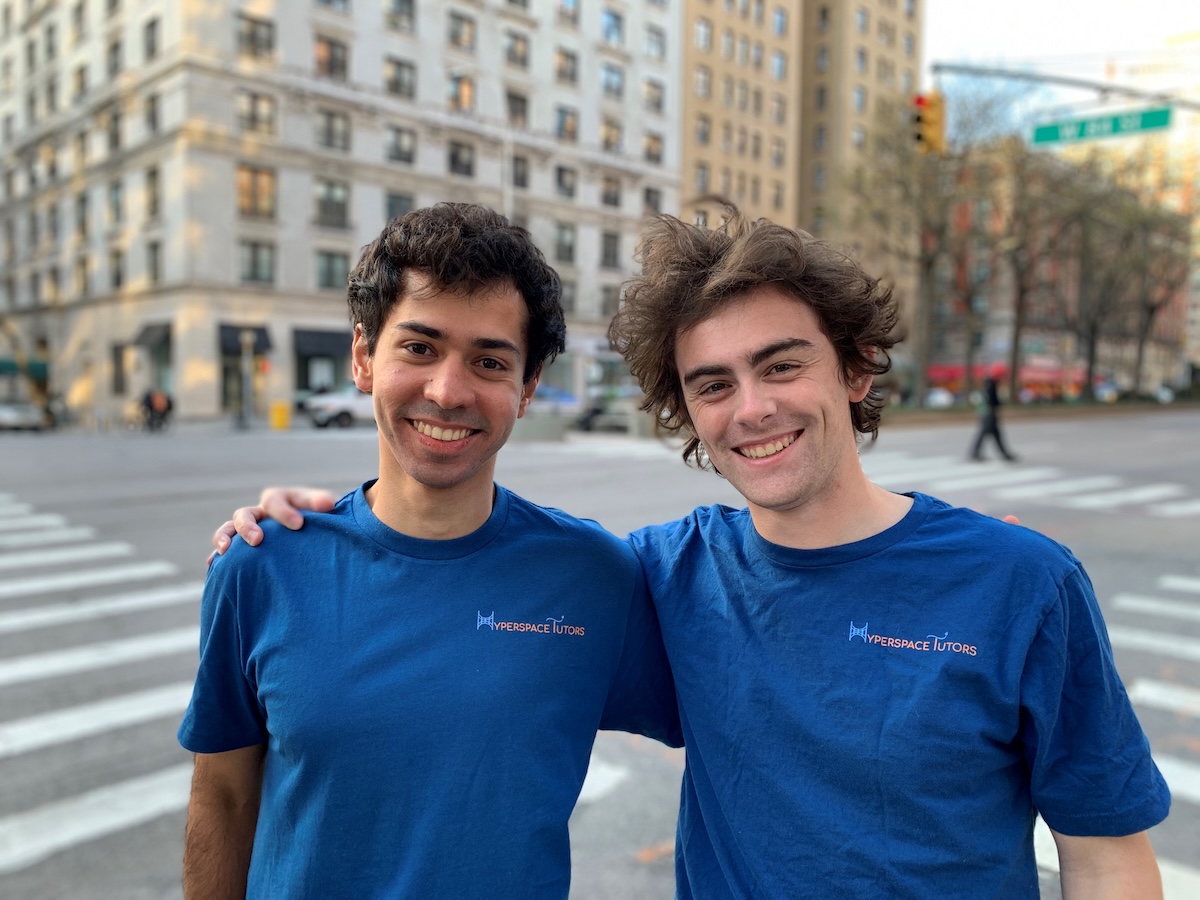
Gabe Matos and Joel Meyers are the founders of Hyperspace Tutors
Careful, there’s a ghost in this article: it’s your student’s living, breathing tutor.
Or at least that’s how the AI overlords might introduce us, as stewards of a bygone era of education. Why hire a tutor when the infinite encyclopedia of the internet can now personally lecture students on any subject at any time with no more than a prompt?
The question we’re asking at Hyperspace Tutors, however, is a little different. In fact, it’s the same question we’ve been asking from the start: given the marvels of information technology, where do today’s students still need support?
Hi, we’re Gabe and Joel, two Columbia grads who met puzzling over physics problems in the lounge of our freshman dorm. Whether volunteering to teach early math literacy, designing online courses for high school students, or swapping notes on our early tutoring endeavors, we became fast friends through a shared passion for helping others love learning as much as we do.
When we started Hyperspace on the wings of the COVID pandemic and our livestreamed graduation, Zoom-weary students needed a reason to love learning again. We quickly found that the technology wasn’t the problem: video conferencing makes education more accessible than ever, but students need a reason to turn on their cameras and unmute their microphones.
We made it our mission, then, to meet students at their interests first and build their learning experience around the things they actually care about. Soccer player cramming for a trigonometry test next week? Let’s talk about how triangles can get you all the way down the pitch. Dancer dreading that next physics quiz? Let’s think about how the mechanics of rotational inertia can help you sail through your next pirouette. To this day, we hand-select our tutors not only for their expertise, but also their commitment to connecting with students through shared interests. With that personal touch that tutoring affords, remote learning becomes an engaging expansion – rather than a dull extension – of the classroom.
Five years later, we’re asking the same question with the rise of ChatGPT and other LLM chatbots: where can we support students who have access to a digital Socrates in their pocket?
It is already clear that students need help navigating how – and when – to use AI at all. If the recent restrictions that NYC schools have placed on generative AI in the classroom are any indication, schools are struggling to help students decide between use cases that help and hinder their learning. Without careful prompting, LLMs spit out walls of text that can lose student attention even faster than a textbook. Worse, without clear, well-prompted guardrails, LLMs are quick to auto-complete entire assignments rather than guide a student to their own understanding. We do students the greatest disservice when we leave them to discern between truth and hallucination from a chatbot that presents every “fact” with unwavering professorial confidence. LLMs may be an inevitable learning tool of the future – look no further than Khan Academy Founder Sal Khan’s book Brave New Words for a convincingly optimistic prediction of AI’s potential to revolutionize education – but used indiscriminately, they threaten to replace critical thinking when they should be empowering students to take their thinking further.
Having long balanced the line between homework help and homework replacement, AI-literate tutors are uniquely positioned to help students navigate chatbot use with more nuance than a classroom curriculum allows. As subject experts, we can turn hallucinations from a pitfall into a learning opportunity on the age-old importance of healthy academic skepticism. Better yet, through one-on-one guidance, we can help students develop prompting habits that direct chatbots to support rather than supplant their personal learning style by restricting output length, citing real sources, or even withholding answers in favor of a more Socratic, step-by-step approach. Successful students in the AI age will be the ones who make sure they are the ones prompting the LLMs, not the other way around.
As tutors, we can also help students develop a healthy ethics around AI. LLMs are incredibly efficient, but efficiency is an opportunity, not an obligation. It is important that students learn there is still value in taking the time to struggle through an assignment, even when you could prompt it away in a second. Why turn to a bullet-point summary of the Gettysburg Address when you can feel proud having spent the time to pick apart the primary source yourself? Why not pat yourself on the back for taking the extra 20 minutes to wrestle through the last step of a tricky integral instead of prompting the explanation? It’s hard for a student who already feels stuck in their learning to see the reward on the other side of effort, and AI only makes matters worse by enticing students to kick the can down the road. Sometimes, the only way out is through, and that’s where a trusted mentor who can guide, empathize, and uplift is poised to help a student appreciate the value in making their own accomplishments.
Looking toward the long-term, human tutors also offer a unique arena in which students can rehearse the interpersonal and communication skills that will be essential in a post-generative workforce re-shaped by AI. For better or worse, proficiencies in copywriting and coding aren’t likely to stand out on future resumes. Rather, employers will hire for the ability to organize, communicate, and delegate high-level strategy; the more that AI takes over the work on our screens, the more we as professionals will have to look up to engage with and motivate the other humans (and bots) around us.
A live tutoring session is a private training ground for these kinds of interpersonal skills. Social media already lures students toward the “safety” of the screen, and it’s no shock that studies already report that students find human tutors more intimidating at first glance than our programmatically cheery counterparts. The stakes of human interaction, though, are a feature, not a bug. The same studies find that by pushing students to express and defend their thoughts on the spot – not to mention navigating the nerves and emotions that bubble up in the process – human tutors are much more effective at teaching students to calibrate toward an emotional common ground with their audience over time. In other words, the longer a student works with a human tutor, the more confident and comfortable they become in communicating their ideas face-to-face. In a mediascape that constantly tries to pull our attention away from one another, any opportunity that helps students develop their facility for face-to-face interaction will give them a leg up in whatever field they choose to pursue.
None of which is to say that our approach as tutors won’t, or shouldn’t, change. Gone, likely, are the days when it was enough to stroll up with a custom sheet of practice problems. ChatGPT can make a hundred such sheets in a fraction of the time, and probably with more depth and breadth (given a well-oiled prompt, of course). Even personal study plans, while they may benefit from the accountability of a live tutor, are easy to generate for any subject and learning style. Instead, we may better serve our students as academic coaches: always there to answer lingering questions (we’re still nerds, after all), but also stewards for helping each student discover and commit to their own ethics – and joy – of learning.
So, to answer our own question, yes: even with AI, we still see opportunity for real tutors to support real students. As long as students and families continue to seek that support, we won’t be closing up shop at Hyperspace anytime soon.
If you or a student you know could use our help navigating the AI age, we’d love to work with you.
Hyperspace Tutors is an NYC-based tutoring service that serves middle, high school, and undergraduate students nationwide in all areas of Mathematics, Humanities, Physics, Chemistry, Biology, Test Prep (SAT, ACT, ISEE, SHSAT), College Essay Writing, and more. Learn more and reach out at www.hyperspacetutors.com.
Gabe Matos is a PhD candidate in Physics at Columbia University, currently working on the CERN particle collider in Geneva, Switzerland.
Though he’s left Physics to Gabe for now, Joel Meyers hopes to play a real scientist on TV one day. He came closest most recently as Albus Potter in Broadway’s Harry Potter and the Cursed Child.


