


Google Maps
169 East 71st Street has spent more than six decades as one of New York’s most recognizable addresses — the Tiffany-blue door where Audrey Hepburn’s Holly Golightly went looking for a cat named Cat. On Monday evening, the townhouse turned up somewhere far less glamorous: the agenda of Community Board 8’s Landmarks Committee, as the only application up for a vote.
It did not go well for the owner.
Advertisement
The committee voted unanimously, 12-0, to disapprove a request to legalize part of the building’s recent renovation that was never approved — a rear wall at the third floor that, as built, extends roughly 21 inches past the alignment the Landmarks Preservation Commission signed off on back in 2016. An architect presenting on behalf of the owner described it as a limited, “as-built condition” that does not strictly conform to the original approval but is barely visible from the street and, in his view, does not change the character of the historic district. The committee was unpersuaded.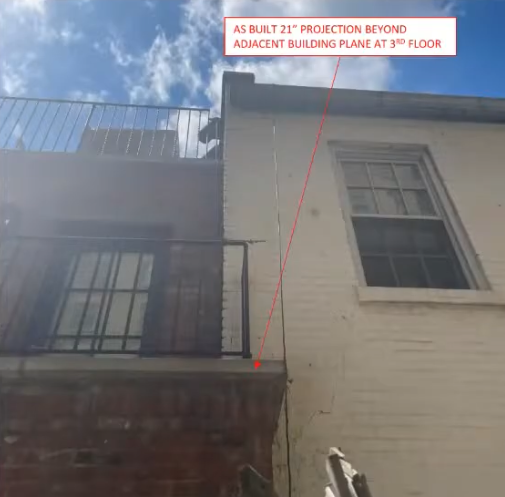
Bertolini Architectural Works, D.P.C.
The disputed sliver sits at the back of the house, where a rear extension and rooftop addition were added during a multi-year gut renovation. According to the architect, the third-floor rear wall was supposed to be rebuilt in line with the neighboring townhouse to the west; instead, a certified survey of the finished building found it landing about a foot deeper than approved, with the wall projecting some 21 inches beyond the building next door. The architect told the committee the discrepancy was discovered only recently, when the owner sought a final sign-off from LPC in order to close out the building’s certificate of occupancy, and characterized it as an honest mistake whose cause could not be fully reconstructed.
The owners of the townhouse immediately to the west, at 167 East 71st Street, did not see it that way. Speaking during the public-comment period, they said the addition was built “right onto” the back of their home and overlaps their facade, and that they had assumed for years it had been properly approved. The wall, the architect countered, sits on a shared party wall between the two buildings and does not cross the property line — a point of genuine factual disagreement that ran through the rest of the meeting. The neighbors said they had not had architects or attorneys examine the condition and could not rule out a different conclusion.
Committee members spent close to an hour weighing whether tearing the wall back would do more harm than leaving it. Several noted that any correction would mean months of demolition and jackhammering for both households, and that original brick salvaged and reused during the renovation could not be saved a second time. Others were blunt about the principle at stake. Co-chair Jane Parshall called it “a moral issue” and said she found it hard to believe the builder did not know a roughly two-foot deviation was being constructed. Co-chair Anthony Cohn walked through the drawings and said it would take a particularly careless contractor to set a wall that far off its approved line, adding that the same error appears to carry up to the fourth floor. At least one member suggested the projecting cornice may also extend slightly over the neighbors’ property, though that was not established.
Advertisement
Monday’s vote is advisory. The application now heads to LPC, which has the final say — and at the same meeting, the committee noted that LPC had recently overridden the full board on a separate Upper East Side matter, raising the question of how much weight the commission will give the board’s objection this time.Hanging over all of it is the sale. The townhouse first hit the market last spring at $15 million, and it went into contract late last year at a last asking price of $12.5 million, according to multiple sources (including Streeteasy). Property and listing records reviewed this week still showed the home in contract rather than closed. The marketing materials lean heavily on the very renovation now in question — the rooftop floor, the southern terrace, the excavated wine cellar — and the owner, identified in real-estate coverage as retired beverage executive Joseph Harkins, had been pursuing the final certificate of occupancy when the unapproved wall came to light.
Here’s the architect’s full presentation.
Have a news tip? Send it to us here!


