
Placemakers of Hunter College / DOT
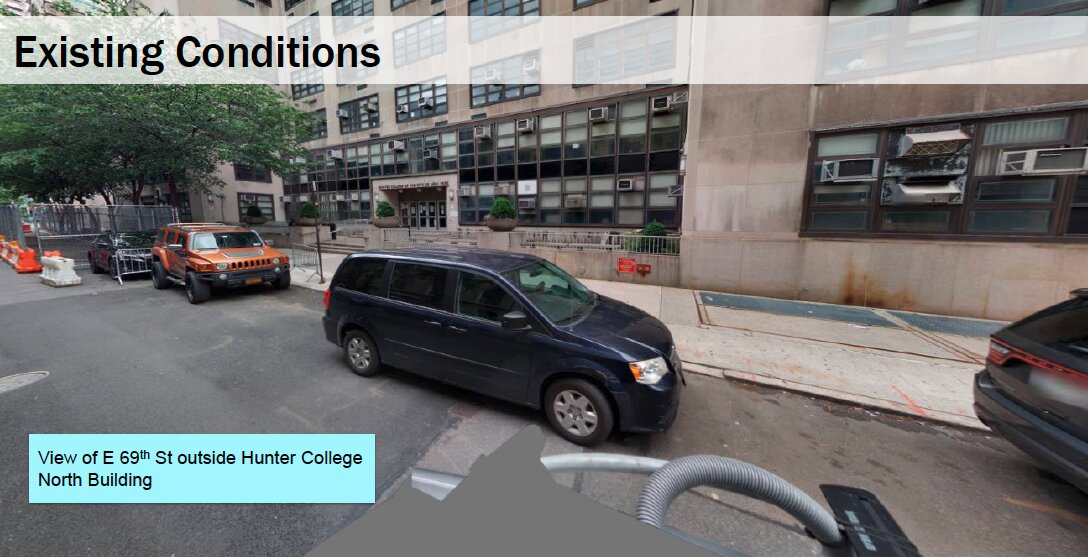
For about two years, a length of curb outside Hunter College’s North Building has sat under construction staging, all but unusable to the thousands of students, residents, and theatergoers who pass it every day. Now a key community board committee has thrown its support behind a plan to turn that asphalt into something permanent — and not everyone on the block is thrilled about it.
Advertisement
At its June 3 meeting, Manhattan Community Board 8’s Transportation Committee voted 7-1, with one abstention, to support a new city “street seat” on the south side of East 69th Street between Park and Lexington avenues. The roughly 900-square-foot space — 138 feet long and eight feet wide, beginning about 60 feet east of the Park Avenue corner — would replace part of the parking lane outside Hunter North with public seating, planters, and greenery.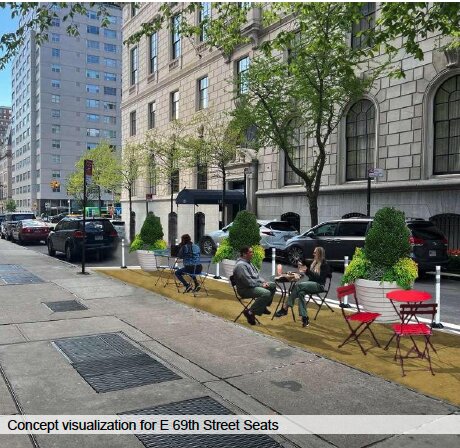
Placemakers of Hunter College / DOT
Unlike the seasonal café platforms many New Yorkers picture, this is the year-round, non-platform version of the program. The Department of Transportation would resurface the parking lane with its standard beige epoxy gravel and add movable bistro tables and chairs, planters, granite blocks, 14 flexible delineators, double white lines, and a neckdown to slow turning traffic. A DOT representative stressed that the space itself would be permanent and open 24 hours a day, 365 days a year, “just like the sidewalk,” with the furniture rolled out and secured daily. The agency’s street seats program is currently being reworked alongside the city’s Dining Out NYC outdoor dining program, and NYC DOT is not taking new applications at the moment, which makes a fresh endorsement like this one comparatively rare.
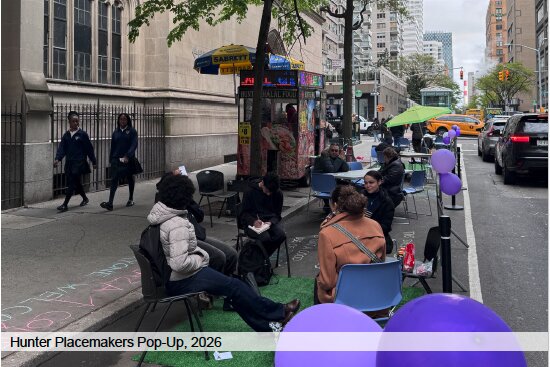
The proposal came not from DOT but from Placemakers of Hunter College, a graduate student-led club out of the school’s Urban Policy and Planning department that formed to push for better public space around campus. The group held pop-up street seats in 2024 and again on Earth Day this spring, then spent April and May on outreach — flyers, an online survey that drew more than 80 responses, door-to-door visits to every building on the block, and a May 27 Q&A for neighbors. Among neighbors surveyed, seating and greenery topped the wish list, with shade close behind. You can share your input here.
Under the plan, Hunter College would sign a maintenance agreement with DOT and serve as the point of contact, handling daily sweeping, litter pickup, planter upkeep, and putting the furniture out and away — likely from around 8 a.m. to early evening, though the exact hours would be up to the college. Hunter’s vice president for administration and operations told the committee the school already keeps cleaning staff year-round, including holidays, and that Hunter Public Safety patrols the area around the clock and can call NYPD when needed. Signage will include a phone number and email for residents to report problems.
Advertisement
The plan’s biggest friction point is parking. The street seat would eliminate two legal alternate-side spaces and a stretch of existing no-parking zone, along with a row of “authorized vehicle only” spots that DOT said were set aside for Hunter faculty back in 1981. A DOT representative told the committee that Hunter administrators don’t believe faculty are actually the ones using those spots, calling it possibly “a case of some light placard corruption,” and said the agency’s traffic team had no problem removing them outright. Much of the block has been unavailable for parking anyway, having sat under Hunter construction staging for roughly two years.Not everyone was sold. One committee member voted no, citing a list of quality-of-life concerns: how the no-noise, no-smoking, and no-alcohol rules would be enforced without a dedicated enforcement body, the risk of attracting illegal food vending, the loss of parking, and the site’s proximity to a historic district. A 69th Street resident questioned why DOT chose a quiet residential block over busier East 68th Street, where two Hunter buildings and steady foot traffic already draw crowds. Presenters said 68th was passed over in part because of its bus route and heavier traffic, and that 69th — wider, shadier, and anchored by the building’s recessed entrance plaza — made for a calmer space. Backers also pointed to the Kaye Playhouse inside Hunter North, saying the seating could give audiences room to gather before and after performances. Another resident, who said he has lived on the block for 30 years, spoke strongly in favor, calling it a net benefit for a neighborhood with little public green space.
The committee paired its approval with a push of its own. The resolution urges DOT to extend daylighting — the practice of keeping the curb near a corner clear of parked cars to improve visibility — all the way to the Park Avenue intersection, building on a daylighting position the full board has already adopted. A DOT representative said the agency was open to extending the design but flagged a nearby fire hydrant and a desire to preserve one legal parking space as complicating factors.
The proposal now heads to CB8’s full board in mid-June, where members of the public will each have two minutes to weigh in during the public session. If it clears that vote, DOT is targeting a fall 2026 installation, ideally around the start of Hunter’s fall semester. The street seat would join DOT seating partnerships with other schools, including Baruch College and Columbia University Medical Center.
Have a news tip? Send it to us here!


