
c/o NYC DOT
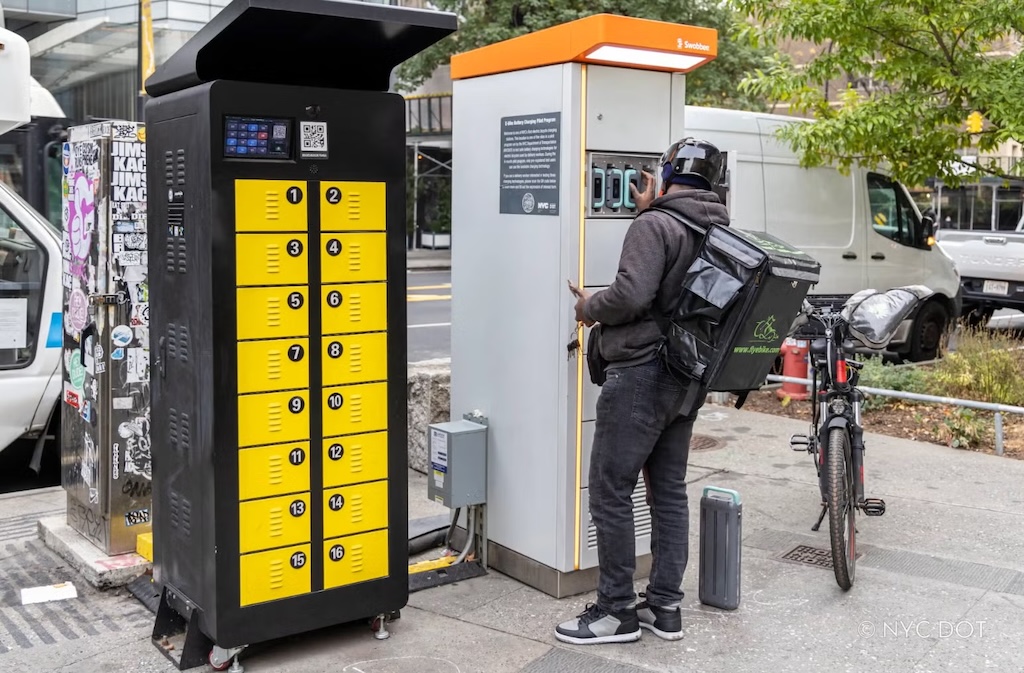
The lithium-ion battery fires that have rattled New York apartment buildings for the past few years are poised to reshape a couple of Upper East Side sidewalks — if the city gets its way. The Department of Transportation is building out a network of public cabinets where delivery workers can trade a drained e-bike battery for a fully charged one, and two UES streets have landed on the agency’s preliminary list. Anyone with an opinion about where that equipment belongs doesn’t have long to share it.
Advertisement
The two proposed UES sites are at 79th and Second Avenue and 73rd and First Avenue. Both are early picks, and neither is locked in. They’re drawn from a citywide pool of 50 candidate locations that DOT intends to trim to roughly 25. The most likely place for a neighborhood airing is Community Board 8’s Transportation Committee, which next meets July 1 at 6:30 p.m. over Zoom — but its agenda had not been posted as of this writing, so there’s no guarantee the item lands on that date.The whole effort grows out of a sobering tally. Since 2022, cheap and uncertified lithium-ion batteries have been linked to more than 900 fires and over 30 deaths in the five boroughs, many of them sparked by riders charging spare batteries inside their homes. DOT’s bet is that if there’s a safe, convenient place to charge on the street, fewer batteries end up plugged in overnight next to someone’s bed.
Here’s how the cabinets work: a rider scans a QR code, slots in a dead battery, and walks away with a charged replacement in less than a minute, so no one is standing around waiting on a charge. The batteries inside meet national fire-safety certification, and the cabinets themselves are designed to be weatherproof, theft-resistant, and capable of containing a fire if one breaks out inside. The agency is funding the rollout — about 25 cabinets across the city — with a $3 million state grant, after a 2024 pilot that DOT says delivery workers embraced.
The financial arrangement, though, is already drawing scrutiny. The riders who use the cabinets would pay a monthly membership fee — roughly $70 at the private swap stations already operating around the city — to a vendor DOT plans to select through a request for proposals later this year. The delivery apps that profit from those same workers are not on the hook for anything.
Advertisement
That structure drew pointed questions when the program came before the Upper West Side’s community board, as our sister site I Love the Upper West Side reported. Speakers there asked why public dollars and the delivery workers themselves are covering the cost while the apps chip in nothing, and — by one attendee’s math, dividing the $3 million grant across roughly 25 cabinets — questioned why a battery-swapping station should run about $120,000 apiece. DOT’s answer was that most of the money pays to run electrical service to each location rather than to buy the cabinets, which would be owned and maintained by private vendors. Others pressed on what would keep a single vendor from hiking fees on a captive set of users, a concern DOT said it is still sorting out alongside how many companies to bring on and how the pricing will be set.Nothing is final yet. DOT holds the pen on the final site list, but residents can submit comments through NYC DOT’s online feedback portal, which closes July 31. From there, the agency expects to settle on its citywide locations by year’s end, start construction in early 2027, and flip the cabinets on in 2028. Those who want to make their case in person can register to join the July 1 session through Community Board 8.
Have a news tip? Send it to us here!


