
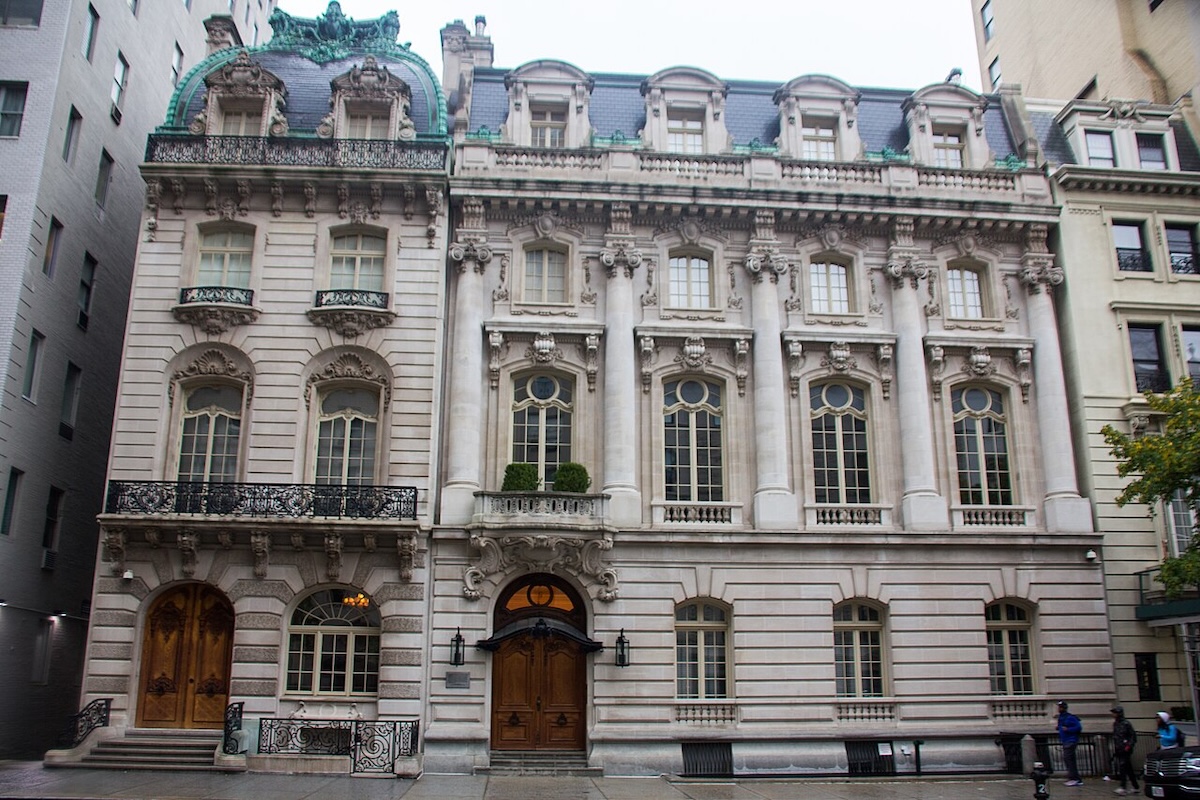
Photograph by Mike Peel (www.mikepeel.net) via Wikimedia Commons
New York’s new tax on second homes produced its first roster of properties last week, and buried in it is the answer to a question New Yorkers have argued about for years: which single home the city considers the most valuable of them all. It’s on the Upper East Side and has been hiding in plain sight for more than a century. And the entity that owns it paid less than a quarter of what the city now says it is worth.
Advertisement
The Department of Finance puts a market value of $112 million on 7 East 72nd Street, between Fifth and Madison avenues, the highest figure attached to any home on the roll. The address is really two addresses. The limestone mansion next door at No. 9 went up between 1894 and 1896 for carpet heir Henry T. Sloane, designed by Carrère and Hastings. No. 7 followed a few years later for financier Oliver Gould Jennings, and its architects matched the arches and ornament of the Sloane house so the pair would read as one building. Both housed the Lycée Français de New York for decades. Qatar bought them from the school in 2002 for $26 million and fused them into a single residence of roughly 45,000 square feet, reported by The Real Deal to be the New York home of Sheikha Al-Mayassa bint Hamad bin Khalifa Al Thani, who is based in Doha.Because the house belongs to a government rather than a person, the priciest individually owned home in the five boroughs is a different one, and it sits about 14 blocks north. The city values the townhouse at 9 East 86th Street at $75.8 million. It belongs to Jenica Paulson, who came away with it in her settlement with hedge fund manager John Paulson after a divorce fight that ran from his 2021 filing through this spring and took in more than $100 million in real estate from the Hamptons to Aspen. She paid $30 million in May to keep the house. Her 2022 suit accusing him of moving assets into irrevocable trusts beyond her reach, which his side said had been created decades earlier for their daughters, ended in a settlement both parties called amicable, according to the New York Post.
Whether the house is worth anything close to $75.8 million is a separate question. An appraiser who reviewed the number for the Post, speaking anonymously, called it very high. Working from a rate of $1,900 per square foot, he put the house nearer $50 million, and noted he might be running low depending on its condition. He also flagged a quirk in how the city counts: the townhouse runs about 28,500 square feet with its rear extension, but the city’s gross building area measurement leaves the extension out, which drops it to roughly 20,500 square feet. The appraiser did not say where his per-foot figure came from, and the Post did not name him.
Advertisement
That gap matters more than it looks, because the surcharge is calculated off the city’s number, not the market’s. The pied-à-terre tax took effect July 1. Through June 2028, one-, two-, and three-family homes carry a rate of 0.8 percent of the city’s market value starting at $5 million, 1.05 percent starting at $15 million, and 1.3 percent starting at $25 million. Condos and co-ops run higher, at 4 percent starting at $1 million, 5.25 percent starting at $3 million, and 6.5 percent starting at $5 million. Primary residences are exempt regardless of value, as are homes lived in by an owner’s immediate family or by a tenant, according to the Department of Finance. On the Qatari house, the annual bill would come to roughly $1.5 million.The roll itself went up July 24 and is an annual legal requirement, not a target list, a distinction lost in the reaction to it. Finance did little to narrow the file before posting, which is why it swept in homes worth a fraction of the thresholds and long-established primary residences. Bloomberg reported that the set the agency actually flagged as potentially owing the surcharge comes to more than 31,000 properties, against the roughly 10,000 officials estimated when the law passed in May. The published file is far larger, running past 960,000 records, and a Finance spokesperson told the Post that state law required releasing a property roll for public inspection, and that the agency will work from it to identify homes that may owe the surcharge.
The neighborhood shows up repeatedly in the file. Jeffrey Epstein’s former townhouse at 9 East 71st Street is carried at $66.8 million, among the ten priciest homes in the city, and Woody Allen, Anna Wintour and Cynthia Nixon appear as well, according to the Post. A sort of the file by Hell Gate also turned up billionaire Leonard N. Stern’s Fifth Avenue house at $37 million and a limestone house off Lexington Avenue belonging to Jerry Speyer of Tishman Speyer at $18.7 million. Appearing on the roll is not the same as owing the tax, and attorneys expect a meaningful share of entries to fall off as owners appeal. Council Minority Leader David Carr found his own Staten Island condo on it and called the release reckless. Council Member Gale Brewer, whose Upper West Side brownstone has been her full-time home for more than 20 years, said her inclusion shows the data cannot be relied on, according to the Post.
The calendar is what matters for anyone who has found a letter from Finance in the mail. Exemption applications are due August 21 for houses and condos and August 24 for co-op units. The main document the city wants is your most recent federal or state tax return. If you don’t have one, any two of a DMV-issued ID, a voter ID card, or other proof of primary residence will do. Renting the place out works too, with a copy of the lease plus a utility bill or proof of rent payment, and a relative living there works with a birth or marriage certificate. Owners unsure whether any of this applies to them can run their address through the city’s eligibility guide.
Advertisement
One wrinkle is worth understanding before you file. Arguing that your home is not a second home and arguing that the city overvalued it are two separate fights heard in two separate places. The first goes to Finance. The second goes to the Tax Commission. If you ask the Tax Commission to settle the residence question, you are required to challenge your value at the same time, and you give up the ability to apply to Finance for the exemption. Anyone who thinks both problems apply to them should sort out that order with an attorney before the August dates.The surcharge, for those who end up owing it, will appear on the property tax bill due January 1, 2027. The full roll stays open for public inspection through December 31 and can be downloaded from the assessments page. City Hall projects the tax will raise about $500 million a year. Comptroller Mark Levine’s office puts it closer to $340 million to $380 million.
Have a news tip? Send it to us here!


