
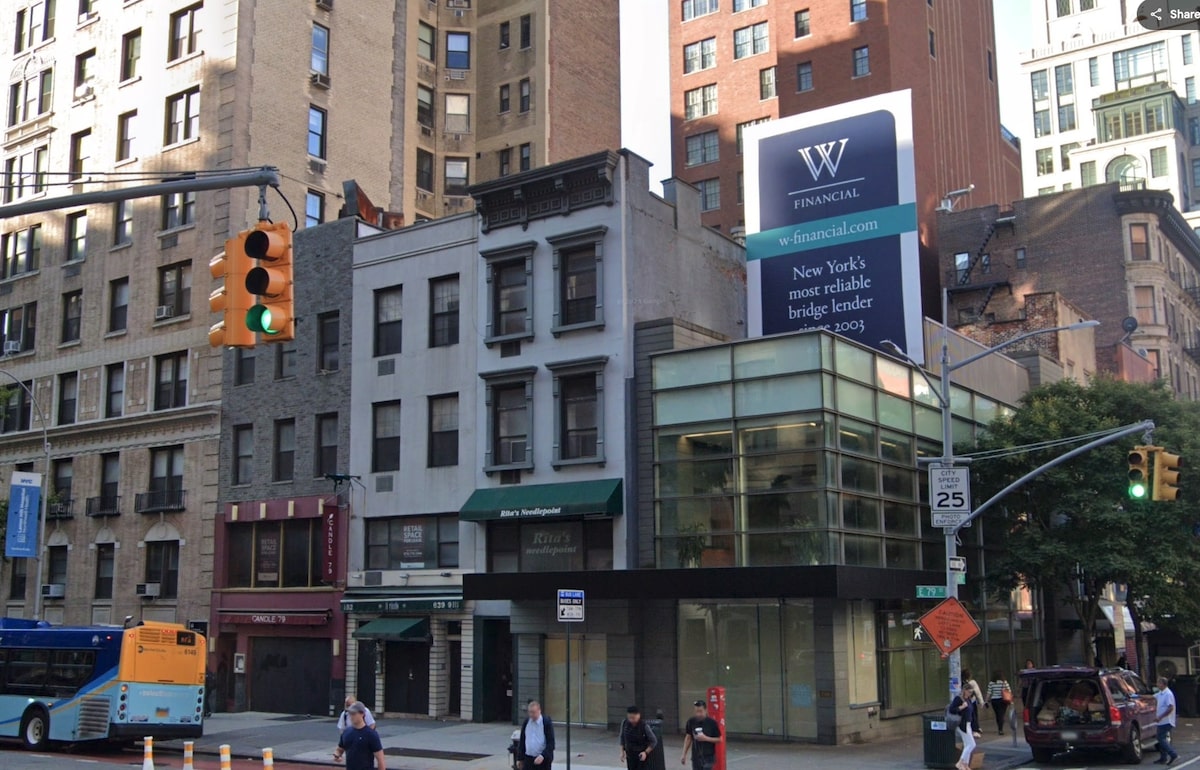
150-154 East 79th Street (Google Maps)
The boutique luxury condo planned for the corner of 79th and Lexington has a new wrinkle, and it’s one that Community Board 8 isn’t thrilled about.
At its April 21 Landmarks Committee meeting (watch here), the board voted 9-4 to approve a proposal that would let two individually landmarked 1861 rowhouses at 159-161 East 78th Street sell off their unused air rights — roughly 8,000 square feet combined — to a development site a block north. That transfer, plus a separate batch of inclusionary housing certificates the developer plans to buy, would allow the new condo building to rise taller than base zoning would otherwise permit.
Advertisement
The 78th Street rowhouses were designed by Henry Armstrong and speculatively built in 1861 by painter John Turner. Both were designated individual landmarks in 1968. Sarah Sher of Higgins Quasebarth and Partners presented the preservation side of the application. Deirdre Carson of Greenberg Traurig served as land use attorney for the transfer.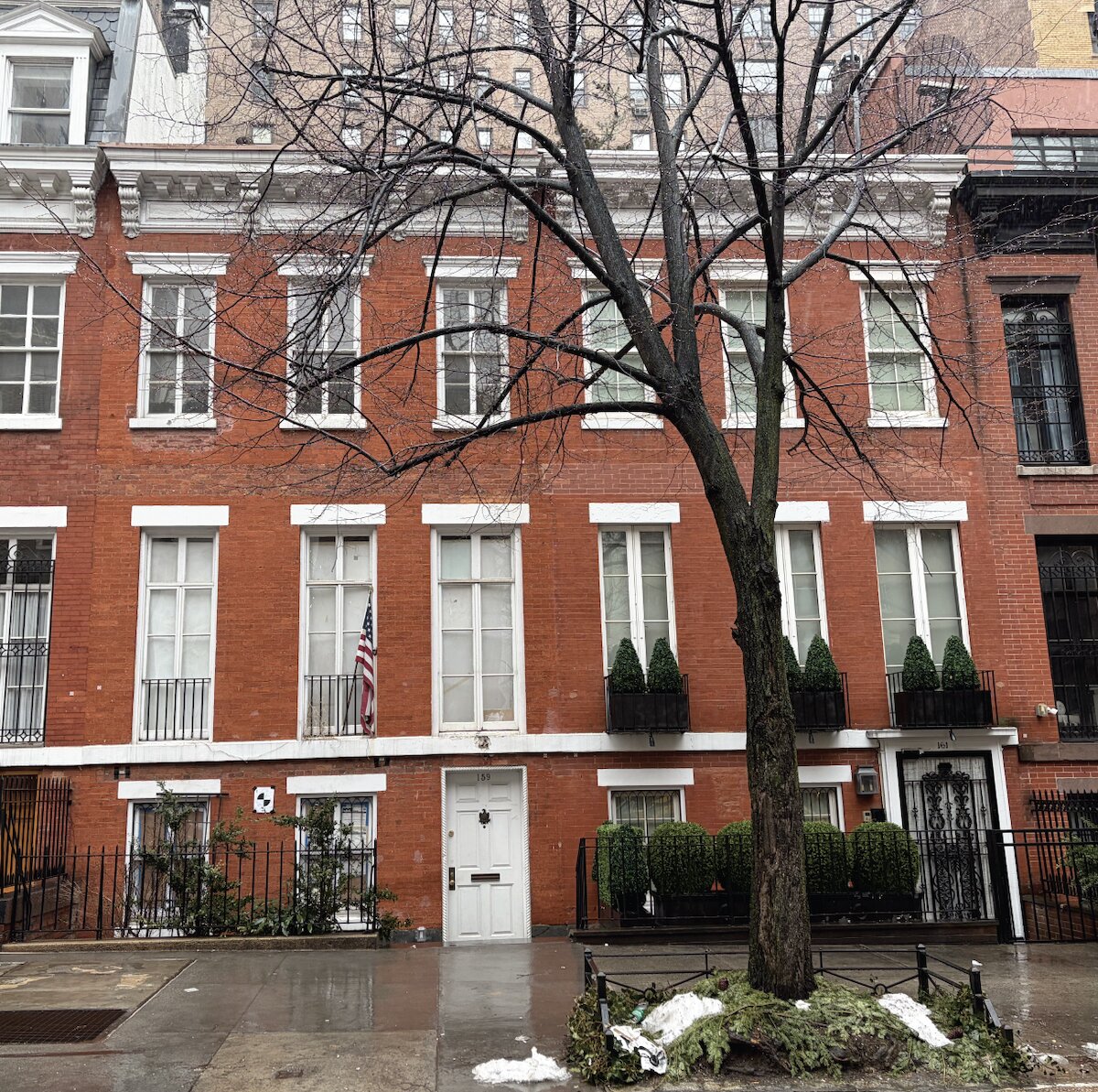
159-161 East 78th Street c/o Higgins Quasebarth and Partners
Carson described the receiving site as a corner assemblage at Lexington and 79th — “a bunch of small commercial buildings” spanning roughly 70 feet on 79th Street and 100 feet on Lexington, with a history of bankruptcy in the prior ownership. She told the committee the developer plans to build “a luxury condominium building” and is “planning to buy some inclusionary certificates to get some more height.” She did not name the developer.
The description matches the footprint of the six-parcel assemblage at 150-154 East 79th Street and 1131-1135 Lexington Avenue that Chinese developer Zhang Xin’s firm Closer Properties acquired from distressed-debt lender W Financial for a combined $76 million, a deal East Side Feed reported last October. The new condo is expected to be addressed 150 East 79th Street.
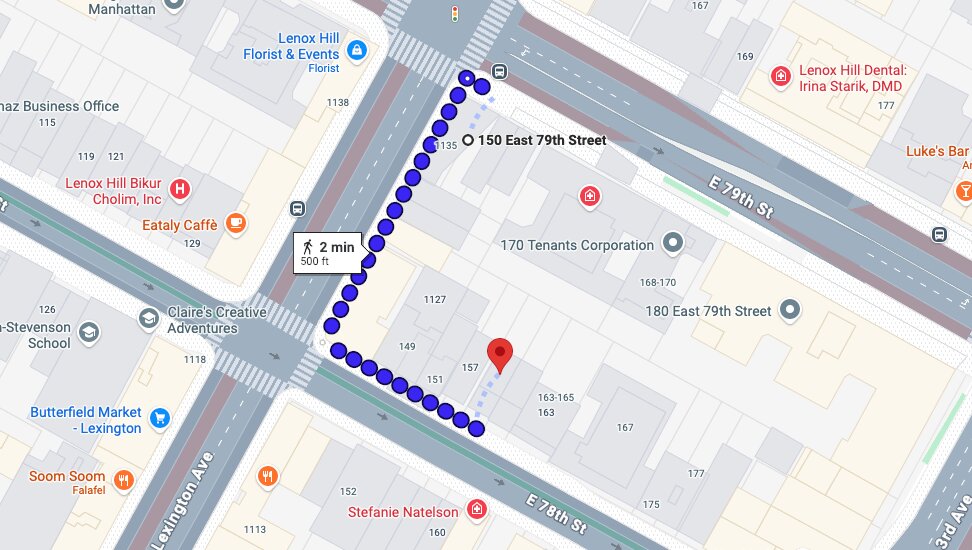
The sites are roughly 500 feet away (Google Maps)
Advertisement
How the math works
The transfer relies on a new section of the zoning resolution — Section 75-42 — that was introduced as part of the City of Yes package in 2025. It makes it dramatically easier for individual landmarks to sell their unused development rights to receiving sites anywhere in a broad surrounding area, without requiring the landmark owner to tie the sale to any specific construction project.
Each of the two rowhouses at 159-161 East 78th Street has about 4,000 square feet of unused development rights. Combined, the 8,000 square feet translates to roughly two additional floors on the receiving site, according to Carson. Closer Properties also intends to buy inclusionary housing certificates — which allow even more height in exchange for affordable housing built elsewhere, often outside the immediate neighborhood — for an additional bonus on top of that.
In exchange for the right to sell the air rights, the rowhouse owners must establish a “continuing maintenance plan” approved by the Landmarks Preservation Commission, including a full structural and facade inspection every ten years. The owners also have to set aside 20% of the sale proceeds for initial restoration work and hold another 10% in escrow for ongoing maintenance costs, according to Carson.
Proposed restoration work on the two rowhouses includes brick replacement where spalling and cracking have occurred, removing incompatible mortar and repointing, repainting the brownstone trim, and replacing the front facade windows at 159 East 78th Street with new wood windows matching the historic configuration.
How tall? Nobody’s saying yet
What the new building will actually rise to remains an open question. Closer Properties has not publicly disclosed a planned height, and at the time of its October 2025 acquisition announcement, the company said only that the project would be a “boutique, amenity-rich” condominium.
At the CB8 meeting, Michelle pressed Carson on the math. Michelle suggested the base zoning on Lexington allows a building somewhere around 210 feet, and Carson said she believed that was approximately right but cautioned that she had not done a detailed zoning analysis of the receiving site and was not the attorney working on the development project itself. The 8,000 square feet of air rights from the rowhouses would add “a maximum of two full floors” on top of whatever the base allows, she said. The inclusionary certificates would add more, by an amount she could not specify.
The opacity is part of what frustrated several committee members. Under Section 75-42, the air rights can be approved and “banked” without any specific receiving-site project attached, meaning the board was being asked to greenlight the transfer without ever seeing what would be built with it.
Advertisement
Four board members voted no
The application passed, but not without friction. Committee co-chair Jane voiced strong opposition to the broader mechanism: “I think this is a boondoggle for these owners of individual landmarks. It’s just a weird set of situations, because if you own a brownstone and you have an individual house, you don’t — unless it’s an individual landmark — you can’t sell the air rights.”
She continued: “We’re giving cash to these owners of these houses. Cash. We don’t know how much cash they’re getting. And then we aren’t supposed to even know where the development rights are being transferred to.”
Member Sarah, who also voted against the application, said the committee typically evaluates air rights transfers by weighing the community benefit against what the developer receives. “Without knowing the other half, it’s hard to say if the presentation that we’re getting is just a measly, you know, piece of chump change, considering what is being given up and the light and air that is being given up.”
Kimberly, another no vote, said the whole application “makes me nervous” and pointed to the one-way nature of the decision: “Once these air rights, the development rights, are gone, they’re gone. There’s nothing else we can do.”
Marco rounded out the four no votes.
Other board members argued the committee’s role is narrower. Co-chair Anthony said the panel is only supposed to weigh “context and appropriateness” — in this case, the maintenance plan for the landmark buildings, not the zoning implications at the receiving site. Adam noted that both the granting and receiving sites are outside any historic district, which further limits the committee’s jurisdiction.
What happens next
The application still requires a public hearing at the Landmarks Preservation Commission before a maintenance plan restrictive declaration can be filed against the landmark properties. Only then can the air rights be transferred, and the new condominium building proceed with the added floor area.
CB8 is also planning a joint meeting between its Landmarks and Zoning committees to address the broader implications of Section 75-42 applications going forward.
Have a news tip? Send it to us here!


