
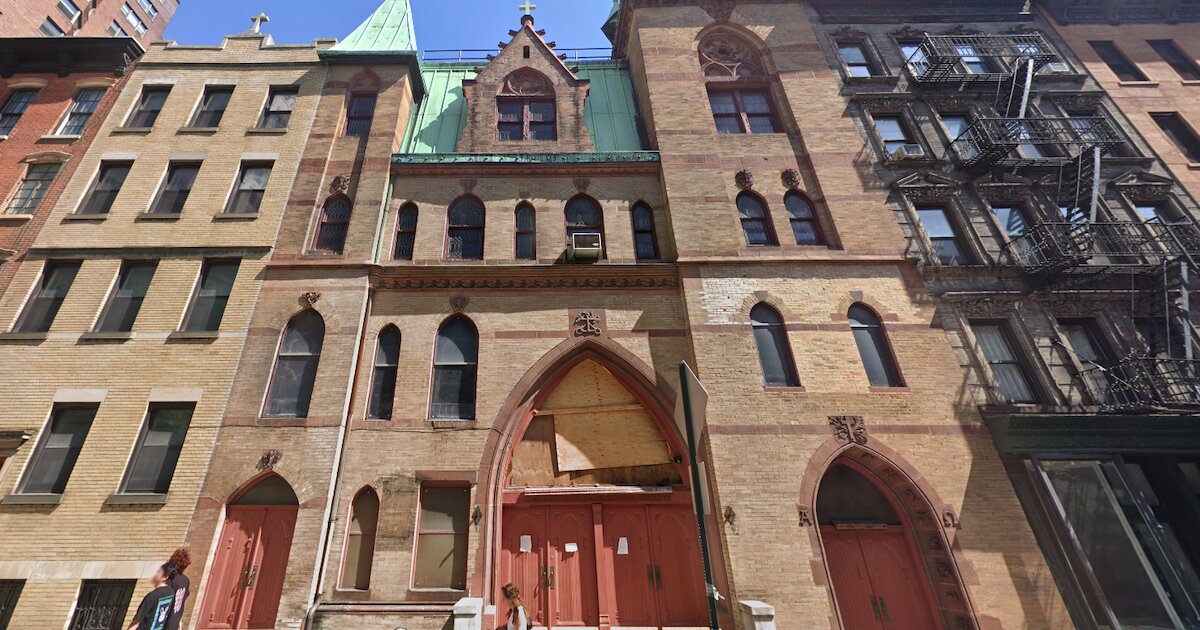
The former church, shown in a Google Maps screenshot from August 2024
Free Upper East Side News, Delivered To Your Inbox
Demolition is well underway at the former Church of St. Elizabeth of Hungary on East 83rd Street, and a local preservation group is calling its destruction a painful example of what’s being lost in Yorkville.
Advertisement
The front of the 1893 church at 213 East 83rd Street (between Second and Third avenues) has already been razed, with only rear interior sections still standing, New York YIMBY reported on Feb. 24. The remainder is expected to come down by late spring.In its place, developer AVENU is planning an 85-foot-tall, seven-story condominium building with eight units, each over 1,500 square feet. The building, which is being designed by Isaac Stern Architects, will span roughly 27,000 square feet — significantly larger than the church — thanks in part to air rights transferred from the adjacent property at 211 East 83rd Street. Paris Forino is slated to handle the interior design.
As ESF previously reported, developer Robert Saffayeh purchased the church for $11.8 million in 2024. The congregation had been relocated to the Church of St. Monica at 413 East 79th Street in 2015, at the direction of Cardinal Dolan, due to low attendance. Permits to demolish the church and construct the new building were filed later that year.
Friends of the Upper East Side, a neighborhood preservation nonprofit, responded with a pointed blog post calling the demolition the loss of “another living link to Yorkville’s past.” For more than a century, the church served as a spiritual home and cultural anchor for generations of German and Slovak immigrants in the neighborhood.
The group and a coalition of neighbors had submitted an urgent request to the city’s Landmarks Preservation Commission (LPC) in August 2024 seeking individual landmark designation for the church. The LPC declined, citing its modest scale, mid-block location, and unremarkable architectural style.
“These cultural and religious spaces for gathering and community are being seen as not sufficiently significant for preservation — and that’s really sad,” Nuha Ansari, executive director of Friends of the Upper East Side, told Patch. “As far as we’re concerned, significance isn’t just about monumentality. It’s about the cultural memory embodied in these buildings.”
Advertisement
Rather than demolition, Friends of the UES argued the church’s central location and spacious interior made it well suited for adaptive reuse — potentially as housing, a community space, or a cultural venue that preserved elements of its historic character.“We envisioned cultural or community programming — something not so far from its original use,” Ansari told Patch, pointing to models like the Center at West Park, an affordable arts center that was evicted from its Upper West Side church last year. “Community spaces are few and far between, and this would have been perfect for that kind of use.”
The group sees the demolition as part of a broader pattern reshaping the neighborhood. Former churches, historic gathering places like the Doelger building on Third Avenue and East 84th Street, and older tenement buildings are increasingly giving way to high-end residential development.
“If Yorkville is to maintain any meaningful connection to the communities that built it, preservation must be proactive rather than reactive,” Friends of the Upper East Side wrote. “Otherwise, its history will survive only in photographs and footnotes, while its physical legacy disappears, one demolition at a time.”
Have a news tip? Send it to us here!


