
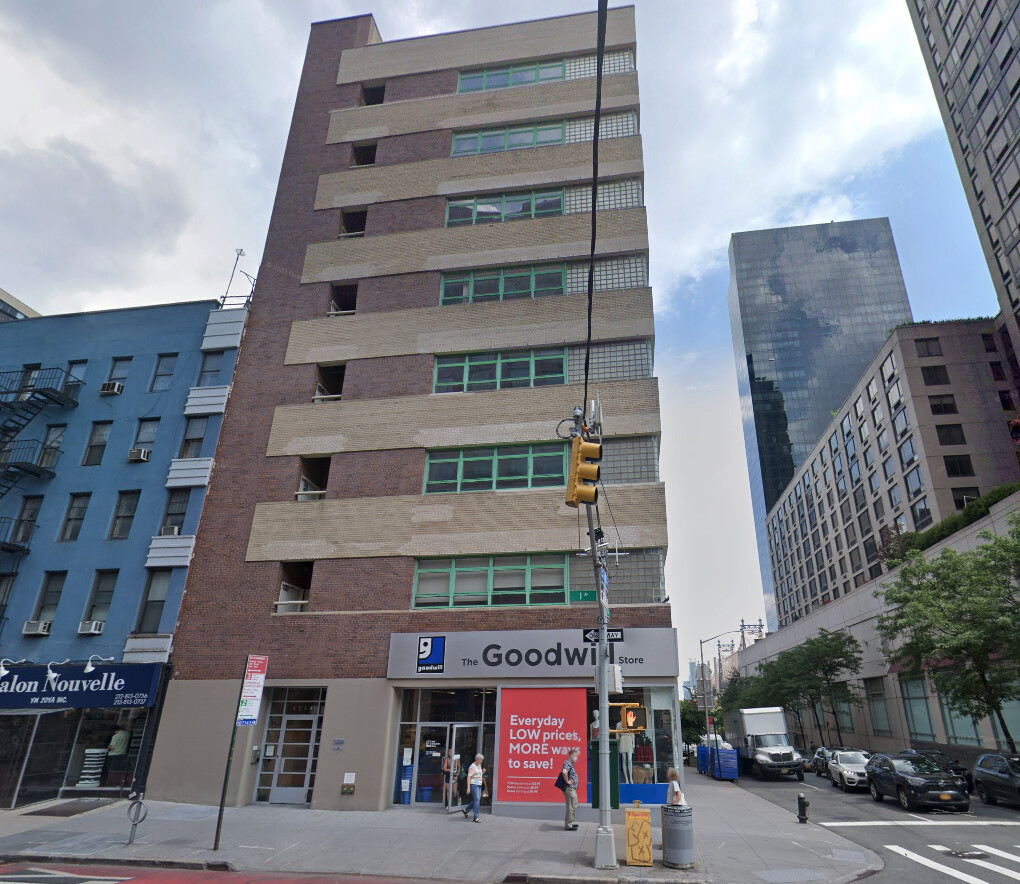
Google Maps
A packed Rockefeller University auditorium hosted a tense Community Board 8 meeting on Monday night on the planned 200-bed women’s homeless shelter at 1114 First Avenue (at the corner of East 61st Street) — and things got ugly fast.
Advertisement
The meeting, which lasted about three and a half hours, featured shouting matches between residents and CB8 Chair Valerie Mason, an exchange in which Mason told an audience member “don’t trip on your way out,” questions about whether the project was done legally, and pointed confrontations over transparency and community safety. More than 250 people joined on Zoom in addition to those who filled the room in person.Representatives from the Department of Homeless Services, the shelter’s operator Housing Solutions of New York, and the security firm Elite Investigations presented details on the facility’s operations, staffing, and security protocols (here is a statement with details we received from DHS late last month, and here is a PDF of the full presentation). But the Q&A session that followed quickly devolved into contentious back-and-forth exchanges that tested Mason’s ability to maintain order.
“I Don’t Want to Hear It”
Mason set the ground rules early, telling the crowd that applause and booing would not be tolerated. “If you disagree with what you’re hearing, I do not want to hear it,” she said. “If you agree with it, you can raise your hand like this.”
It didn’t hold.
The first public speaker, Gary Wachtell (sp?), president of a 225-unit co-op on York Avenue, went well over his allotted one minute while questioning why the community received so little notice about the shelter. When the crowd reacted audibly, Mason cut in: “Obviously, no one is going to listen to the rules.”
The exchange escalated when Wachtell challenged the notification process, comparing it unfavorably to the public notice required for sidewalk café permits. Mason pushed back, correcting him on the timelines and noting there is no mandatory notification period for shelter openings. When Wachtell continued, Mason told him his time was up.
When another person in the crowd interjected (it wasn’t 100% clear what he said) and appeared to head for the exit, she added: “Have a nice evening. Don’t trip on your way out.”
Advertisement
After a DSS representative claimed the community was notified about the shelter in March 2025, the crowd started loudly booing and Mason jumped in to correct him (as news of the shelter site was not shared with the public until January 2026).Mason vs. State Senate Candidate
One of the sharpest exchanges came when Alina Bonsell, an Upper East Side resident running for New York State Senate in District 28 as a Republican, took the microphone. Bonsell introduced herself as a parent of two children and questioned how the shelter “could have gotten by” State Senator Liz Krueger and Speaker Menin.
“I appreciate the comment, but we all know who you are,” Mason interjected.
Bonsell then pressed DHS on the screening process, asking about criminal history checks, mental health assessments, and prior shelter behavior. After DHS explained the intake process and confirmed they do not drug test residents, Bonsell appeared to reference her Senate campaign.
Mason cut her off again. “I’ve warned you before about this. This is not a forum to promote your candidacy.”
The exchange grew heated, with Mason telling Bonsell she was being allowed to speak out of turn. “Keep yelling at me. Thank you. That really moves the conversation along.”
Bonsell responded to the exchange in an Instagram post shared after the meeting.
Advertisement
Zoning and Legality Questioned
Resident Andrew Wolf (sp?) raised what became one of the evening’s most substantive lines of questioning, challenging the legality of the project’s zoning and permitting process. Wolf noted that the property’s C8 zoning designation is for heavy commercial and manufacturing use and “expressly prohibits housing.”
“I do not understand how the DOB could possibly have inspected any of this work,” Wolf said. “Unless the owner is hiding another set of plans, there’s no possible way this could be legal.”
Daniel Nicholas, an assistant commissioner at DSS, confirmed that a “rooming unit letter” — which allows the site to be used as a temporary housing facility without a full zoning change — had been approved by the Department of Buildings. However, he acknowledged that a Temporary Certificate of Occupancy had not yet been issued.
“We cannot open the site until we get a TCO,” Nicholas said. “If we don’t get a TCO, the site doesn’t open.”
Wolf requested a written legal analysis proving the process was done correctly. Mason called the request “fair.”
Mason later told the audience that CB8 had hired its own zoning consultant to review the project, and that “as of today, everything that they’ve done seems to be in order.”
Security Concerns — Inside and Out
Much of the evening’s tension centered on what happens outside the shelter’s walls. Elite Investigations CEO Dan Quinn presented the security plan: six officers per shift, 136 cameras, 24/7 coverage, magnetometers at the entrance, and trauma-informed de-escalation training.
But residents pressed on the limits of that plan. When one resident asked who would patrol the surrounding blocks, Quinn acknowledged: “We are responsible for security for this building” and its immediate perimeter — not the broader area.
“You haven’t done your job then,” the resident responded.
Resident Iris Rubin (sp?) challenged the decision to allow smoking on the shelter’s rooftop terrace, noting that her own 154-unit co-op bans rooftop smoking and that a children’s playground sits a block away. She also questioned why security guards would be unarmed, arguing that “by the time you call Elite, and by the time you get Elite to call the police department, that person is dead.”
Quinn responded that armed security “actually escalates situations more than it de-escalates,” adding: “This is all about de-escalation.”
Advertisement
19th Precinct Pledges Increased Patrols
Deputy Inspector Noreen Lazarus, commanding officer of the 19th Precinct, addressed the crowd directly, pledging that the shelter “will get increased patrols.”
“I can’t predict what’s going to happen when the shelter opens, or what the street conditions will be like,” Lazarus said. “What I want to do is assure you that we will be there to address them.”
She urged residents to attend the precinct’s monthly community council meetings and to report concerns through 311 and 911 calls, which she said directly inform how she deploys her approximately 150 officers.
Supporters Push Back on “Nimbyism”
Not everyone in the room was opposed. Several speakers, both in person and on Zoom, voiced support for the shelter and pushed back against what they characterized as fear-based opposition.
“I actually wanted to speak in favor of the shelter today, which I didn’t expect to be such a controversial opinion,” said Alexis Keller (sp?). “I don’t see a lot of good neighbors in the room tonight. You’ve talked over people. This woman is a volunteer.”
Stefan Loudner (sp?), who lives near the existing shelter on East 91st Street, went further, saying he supported the project in its original form as a men’s shelter. “The decisions here need to be made based on need and not fear,” he said. “Let’s call a spade a spade … this is not at all about safety. It’s about wanting a shelter not to be here at all.”
Board member “Sam” noted that other council districts house far more shelters — citing colleagues who reported 11, 25, 30, and even 45 shelters in their districts. “Here we are complaining about our third. Shame on us,” he said.
Melinda Greenblatt (sp?), who lives near the HSNY Welcome Center on 91st Street, said she didn’t even know the facility existed until the meeting. “I go past there on the bus. I go past there walking. And I have never seen people outside,” she said.
Advertisement
Mason’s Closing: “This Model Is Terrible”
Perhaps the most striking remarks came from Mason herself at the end of the meeting. After nearly three and a half hours, she offered a candid personal assessment.
“From my own personal point of view, I think this model is terrible,” Mason said of the congregate shelter format. “I don’t think anybody wants to come off the street and live with 13 strangers in a room.”
She said that if she had her choice, the facility would house women and children rather than single adults. “The Upper East Side has the best schools in the city, and we can offer children and parents some of the best education,” she said. “We weren’t presented with that.”
DHS officials said the shelter’s 200-bed capacity would ramp up over two to three months rather than all at once. HSNY CEO Seth Muraskin noted that the organization is still awaiting a TCO, and that an FDNY inspection was scheduled for the day after the meeting.
A change.org petition opposing the shelter has now surpassed 5,000 signatures.
DHS said 78% of the women expected to reside at the shelter will have jobs. The average length of stay is projected at nine to 12 months.
Residents who wish to submit written testimony can do so through this form.
Have a news tip? Send it to us here!


